
Uncovering actionable unmet user needs
Unlocking the value of insights — an understanding that became the basis of the product roadmap
The opportunity
While user research was already taking place within Stepstone, insights were not consistently shaping product decisions. Teams had access to research, but there was no shared, practical framework for translating it into prioritisation, solution design, or value proposition development.
The goal was not only to define Jobs to be Done, but to make the organisation fluent in using them as a decision-making tool.
Building out the jobs to be done
I partnered with Vendbridge, a specialist research agency, to design and deliver a Jobs to be Done study using their Customer-Focused Innovation (CFI) framework — a quantitative approach to uncovering and prioritising unmet user needs.
The research combined 52 in-depth qualitative interviews across the UK and Germany, spanning two distinct user segments: job browsers (people passively monitoring the market) and active job seekers. This dual-segment lens was important — the two groups have fundamentally different emotional states and decision-making contexts.
The qualitative phase surfaced distinct emotional pain areas that cut across both segments. Job browsers were largely held back by fear and uncertainty — anxious about making the wrong move, worried about the emotional cost of change. Active job seekers faced a different set of pressures — navigating rejection, managing confidence through the interview process, and uncertainty about their own market value.
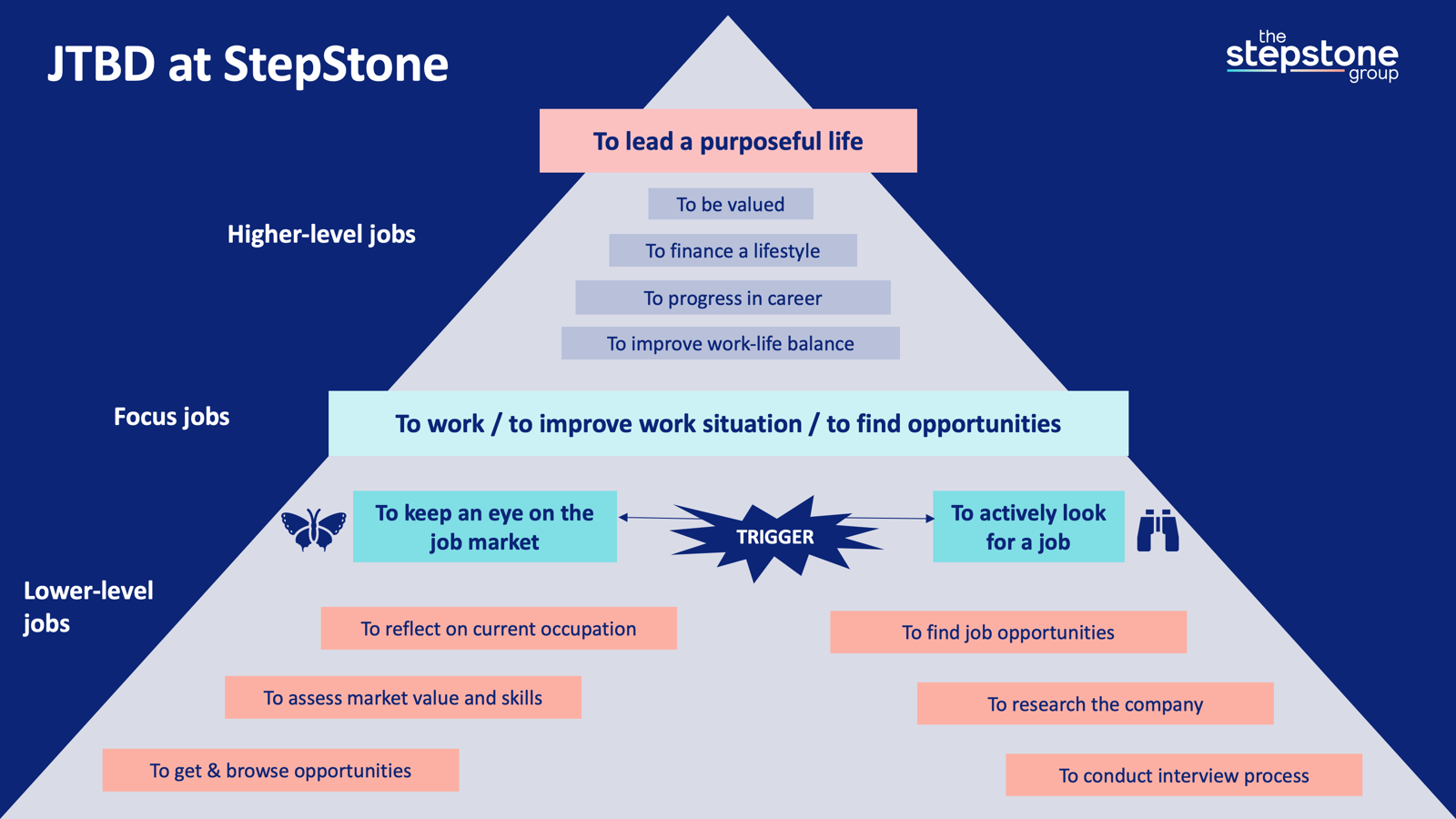
These emotional dimensions were then validated quantitatively to create a prioritised set of job metrics: measurable, outcome-oriented statements that captured what users were actually trying to achieve or avoid. The output was a comprehensive JTBD hierarchy mapped across key stages of the job seeker lifecycle, forming a shared foundation for product thinking.
Activating the product org
To ensure the insights translated into practice, I led a 7-week activation programme supported by two dedicated functions:
- Activation team — responsible for embedding JTBDs into product domains and ensuring relevance at team level
- Training team — responsible for capability building and enabling teams to apply JTBD thinking independently
The programme opened with a leadership phase — a remote presentation and in-person workshops in London for senior stakeholders, delivered by Vendbridge. This was followed by five weeks of portfolio-specific training, run remotely across four product domains: Candidate Data & Marketplace, Job Discovery & Apply, Engagement, and Retargeting.
Rather than relying entirely on the external agency to deliver all training, we developed eight internal trainers from Product and Research through a “train the trainers” model — giving the programme long-term legs beyond the initial rollout.
This programme included three key components:
1. Domain-specific insight translation
We produced tailored insight packs for each product domain:
- A shared overview of the full JTBD framework
- Deep dives into the specific JTBDs relevant to that domain
- Clear articulation of user pain points and unmet needs in each area
This ensured teams understood both the system-level context and their specific opportunity space.
2. Hands-on training workshops
We ran structured workshops across Product, Design and Engineering teams focused on practical application. These sessions taught teams how to:
- Map existing solutions against JTBDs to identify gaps and misalignment
- Reframe features as responses to specific user pain points rather than internal requirements
- Identify opportunities for improvement within existing journeys
- Develop new value propositions grounded directly in JTBD insights
3. Embedding expectations into delivery
We established a clear expectation that all new initiatives should explicitly reference JTBDs as part of their justification for prioritisation and progression.
The outcome
The programme trained 120 people across Product, Design and Engineering — shifting JTBDs from a research output into a working language for product development and decision-making across the organisation.
JTBDs became a required input into discovery and roadmap prioritisation, ensuring that new initiatives were explicitly grounded in validated user needs rather than internal assumptions or feature ideas.
This created:
- More consistent framing of opportunities across teams
- Higher quality product discussions, shifting from solution-led to need-led thinking
- Stronger alignment on prioritisation decisions through a shared reference framework
- Increased confidence in generating new value propositions directly from user insight rather than intuition